
 English
Views: 0 Author: Site Editor Publish Time: 2026-10-29 Origin: Site

In the past, DC withstand voltage tests were widely used for on-site insulation testing of cables and rotating electrical machines, valued for their compact size and low power requirements for capacitive test samples. However, over two decades of global field practice and industry research have shown that applying high-voltage DC to XLPE (cross-linked polyethylene) solid-insulated cables poses serious hidden dangers.
DC withstand voltage tests leave harmful space charges within the XLPE insulation. Even if the cable passes the DC withstand voltage test completely, the residual static charge can trigger a sudden insulation breakdown upon reconnection to the AC power grid, creating a "false pass" phenomenon that masks actual insulation defects.
Ultra-low frequency (VLF) withstand voltage tests output an alternating polarity electric field, more closely mimicking the actual operating stress of the power grid and avoiding the hidden insulation damage caused by space charges. Today, VLF has evolved from an alternative solution into a mainstream testing method for power grid maintenance, EPC contractors, and third-party testing organizations. This article analyzes the underlying technical differences, on-site fault scenarios, key points for equipment selection, and actual return on investment, and introduces our company's VLF series of fully electronic ultra-low frequency high-voltage generators.
1. Hidden risks of DC withstand voltage in XLPE solid insulated cables
DC withstand voltage testing is a mature method for traditional paper-insulated PILC cables, as the paper insulation material does not easily trap static charge. However, the operating conditions for modern, widely used XLPE and EPR extruded polymer cables are completely different.
When XLPE insulation is subjected to continuous unidirectional DC high voltage:
1. Charge is injected and trapped in the micropores and material interfaces within the polymer, forming space charge.
2. Even after a full discharge following the test, some trapped charge cannot dissipate quickly.
3. When the cable is reintroduced to a 50/60Hz AC power grid, the residual space charge superimposes on the operating electric field, causing the local field strength to far exceed the cable's design threshold, leading to electrical treeing aging.
4. The cable may experience catastrophic breakdown several days to weeks after passing the DC withstand voltage test.
There is also a defect shielding effect: Under DC voltage, space charge accumulates around microcracks and water tree defects, reducing the actual field strength at those locations. Some genuine insulation defects will not break down under DC, giving a false pass result, leaving hidden dangers inside the cable.
▎Note: DC withstand voltage testing is not completely obsolete and is still applicable to traditional paper-insulated cables and some fault location scenarios. According to modern industry guidelines, it is not recommended for acceptance testing or preventative testing of new XLPE cables.
2. How VLF Ultra-Low Frequency Testing Overcomes the Fundamental Defects Mentioned Above
VLF outputs sinusoidal AC current, with a standard main frequency range of 0.1Hz, while also supporting 0.05Hz, 0.02Hz, and 0.01Hz. 0.01Hz is primarily used for ultra-large capacitor test samples such as submarine cables and large hydroelectric generators. The polarity reverses every half cycle, preventing charge from being permanently locked inside the insulation material, thus replicating AC dielectric stress and preventing the generation of persistent space charge.
From the formula capacitive reactive power Q=2πf・C・U², it can be seen that reducing the test frequency from 50Hz to 0.1Hz significantly reduces the required test power. Therefore, VLF can achieve the dielectric assessment effect equivalent to power frequency withstand voltage without requiring the bulky and cumbersome equipment of power frequency resonant withstand voltage testing, making it ideal for large capacitor test samples such as long cables.
VLF Field Core Advantages
Realistic Insulation Condition Assessment: Detects water treeing, joint defects, and mechanical damage that are easily shielded in DC operation. Test failures more closely reflect the fault risks under actual AC operation.
Non-destructive to XLPE/EPR Polymer Insulation: No residual space charge risk after testing.
Portable in the Field: Compared to power frequency AC withstand voltage tests, the equipment offers significant advantages in weight and size for large-capacitance test items such as long cables, generator stators, and capacitors.
Compliant with Global Standards: Meets DL/T849.4-2024 (released December 2024, implemented June 2025, replacing the old version DL/T849.4-2004); G-VLF is also backward compatible with the evaluation logic of the old 2004 version standard and complies with the general technical guidelines of IEEE and IEC for medium-voltage cable handover and maintenance.
3. Mechanical vs. All-Electronic VLF Testers – Key Procurement Considerations
VLF equipment on the market is divided into two generations of architecture: mechanical switch type and modern all-electronic type (CHONGQING GOLD G-VLF is all-electronic).
▎The table below is based on practical experience accumulated in the industry and is not standard, written test data.
| Item | Mechanical‑switch VLF | Electronic‑type VLF (VLF Series) |
|---|---|---|
| HV Polarity switching | Mechanical high‑voltage contact switch | Solid‑state electronic switching |
| Output waveform | Square / trapezoidal wave | Pure sine‑wave output |
| Energy handling | Dissipate surplus capacitive energy via high‑power resistors (low efficiency) | Feedback excess power back into internal circuit, higher efficiency |
| Operating noise | High mechanical‑switch clicking / arcing noise | Quiet solid‑state operation |
| Service life | Limited; contacts wear, carbon‑build‑up needs regular overhaul | Practically unlimited high‑voltage switching life, no moving HV contacts |
Traditional mechanical VLF equipment, after repeated field operations, is prone to contact erosion and waveform distortion, leading to unexpected shutdowns. Modern fully electronic VLFs eliminate high-voltage moving parts, resulting in higher reliability under heavy-duty field maintenance conditions.
VLF Series Designed for Key Field Characteristics
- Multiple test frequencies available: 0.1Hz / 0.05Hz / 0.02Hz / 0.01Hz; 0.01Hz is suitable for extra-large capacitance samples;
- 7-inch color capacitive touchscreen with real-time waveform display;
- Fully automatic process: self-test → voltage boost → constant voltage hold → automatic voltage reduction and discharge;
- High and low voltage dual-sided overvoltage and overcurrent rapid protection (≤10ms action);
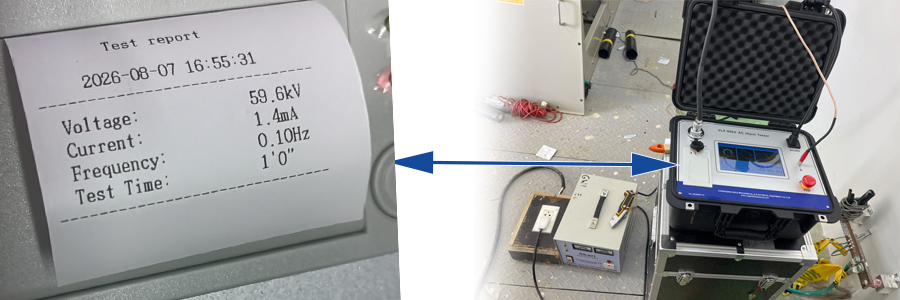
- On-board storage of historical data, on-site thermal printing of reports, and USB export to PC;
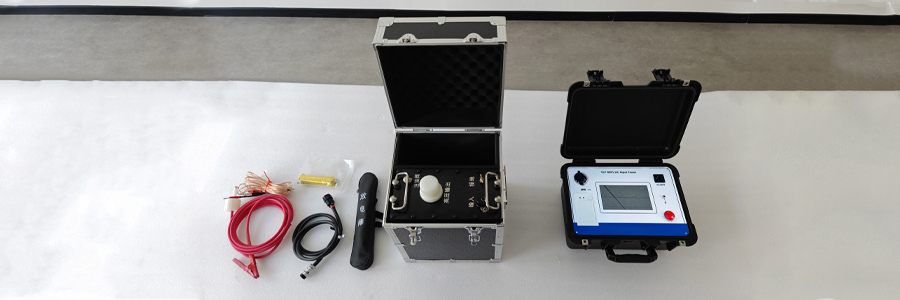
- Separate controller and booster cylinder design for easy transport to substations and cable sites.
▍Field Precautions: Note the maximum allowable sample capacitance of the instrument. When the capacitance of the object under test is less than 0.05μF, an external parallel auxiliary capacitor is required to ensure waveform stability. Follow the instrument operation manual.
4. Typical Application Scenarios and Return on Investment Analysis
New XLPE Cable Handover and Acceptance
New medium-voltage cables are high-value assets. Using VLF (Vacuum-Assisted Fluid) instead of DC withstand voltage testing avoids hidden damage caused by space charge from the project handover stage, prevents cable breakdown after commissioning, avoids rework and contract claims, and protects the reputation of EPC companies.
Preventive Maintenance of Existing Cables
Power grid companies conduct cable condition surveys. VLF can detect latent defects such as joint insulation and water treeing, guiding targeted replacement and avoiding random power outages.
Generator, Large Motor, and Capacitor Factory and Field Testing
In addition to cables, VLF is also suitable for withstand voltage testing of generator stator windings with large capacitors and parallel capacitors, solving the problem of excessively large power frequency withstand voltage equipment.
From an investment return perspective: Although the procurement cost of VLF is higher than that of simple DC withstand voltage equipment, it reduces the risk of premature asset failure, reduces emergency repair expenses, and meets the equipment technical requirements of more and more owners' tender documents, thus possessing clear economic value.
DC withstand voltage testing is suitable for traditional paper-insulated cables, but its use with modern XLPE/EPR extruded insulated cables presents a recognized risk of space charge. The global power industry is gradually shifting to VLF (ultra-low frequency sinusoidal withstand voltage) testing, which provides insulation assessment close to real-world AC operating conditions without causing permanent insulation damage.
When selecting a VLF, it is important to distinguish between older mechanical switch VLFs and more reliable all-electronic generators, such as the CHONGQING GOLD G-VLF series. Key factors to consider include waveform quality, protection response speed, report output capability, multiple frequency ranges, and test sample capacitance limits.
“Need complete parameters for VLF equipment used in cable and rotating electrical machine insulation testing? Contact us for project technical advice.”
【Inquiry / Technical Consultation】
