
 English
Views: 11 Author: Site Editor Publish Time: 2026-09-11 Origin: Site

Efficient and safe power testing is fundamental to the reliable operation of the power grid. Whether it's commissioning testing of newly built substations, routine maintenance, or troubleshooting, the accuracy and safety of test results largely depend on the selection of the right equipment. In the power industry, testing work is generally divided into two main categories: primary equipment testing and secondary equipment testing.
This article will provide you with a comprehensive selection guide to help you distinguish between primary and secondary testing equipment and choose the best solution for your specific needs.
What is primary equipment testing?
Primary equipment refers to the main power system equipment that directly participates in the generation, transmission, transformation, and distribution of electrical energy. It mainly includes:
Power transformers
High-voltage circuit breakers
Disconnecting switches and grounding switches
Instrument transformers——current transformers and voltage transformers
Surge arresters
Power cables
Reactors and capacitors.
The focus of primary equipment testing is to verify the insulation performance, conductivity, and mechanical/electrical operating characteristics of these high-voltage devices. The aim is to ensure that the equipment can operate without failure under normal and abnormal conditions.
Core test parameters for primary equipment:
Insulation resistance and dielectric loss
Withstand voltage test—AC/DC
DC resistance —winding resistance and loop resistance
Turning ratio and polarity
Mechanical operating characteristics —stroke, speed, synchronicity
Leakage current and reference voltage —surge arrester
Selection considerations:
When selecting primary testing equipment, special attention should be paid to the voltage and current capacity ratings. For example, the output voltage of a cable DC withstand voltage tester may need to reach over 100 kV; a circuit breaker characteristic tester must have both high-current loop resistance measurement and high-precision time acquisition capabilities. Furthermore, due to the high-energy hazards involved in the testing, the equipment must be equipped with comprehensive safety functions such as overvoltage, overcurrent, and arc protection.
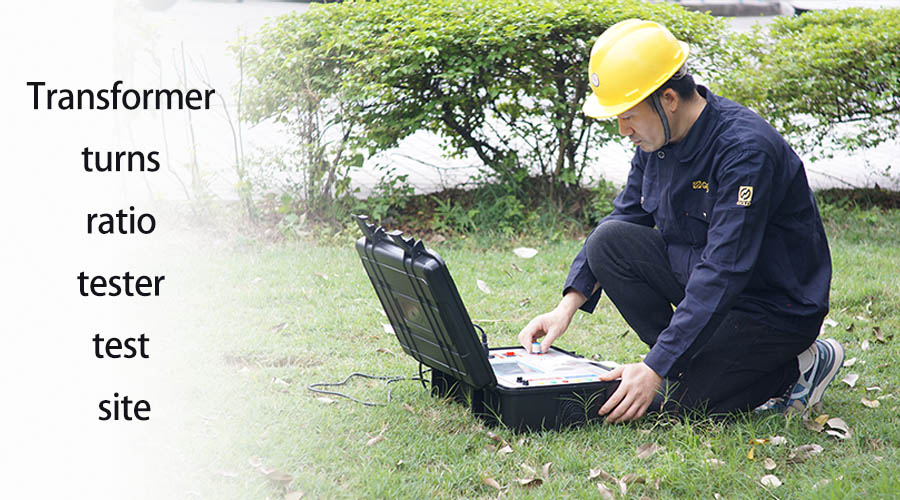
Transformer testing series products ←
What is Secondary Equipment Testing?
Secondary equipment refers to low-voltage equipment used for measuring, controlling, protecting, monitoring, and automating primary systems. Typical examples include:
Relay protection devices
Measurement and control devices
Fault recording devices
Automatic transfer switch for backup power
Metering and monitoring devices
Secondary circuits and tripping circuits
The focus of secondary equipment testing is to verify the logic, accuracy, and response time of these low-voltage control and protection systems. Test instruments do not apply high voltage; instead, they reproduce fault conditions by simulating electrical quantities such as voltage, current, frequency, and phase to check whether the relay protection or control devices operate correctly.
Core test parameters for secondary equipment:
Initial and return values
Action time and coordination
CT/PT ratio and load
Logic sequence and interlocking
Communication protocols —IEC 61850, Modbus, DNP3
Selection Considerations:
Secondary testing places extremely high demands on high precision and automated software. Modern relay protection testers must be able to output high-precision, multi-phase synchronized signals and support automated test sequence and report generation. With the increasing adoption of IEC 61850 digital substations, test equipment also needs to support sampled values (SV) and GOOSE messages to verify digital protection schemes.
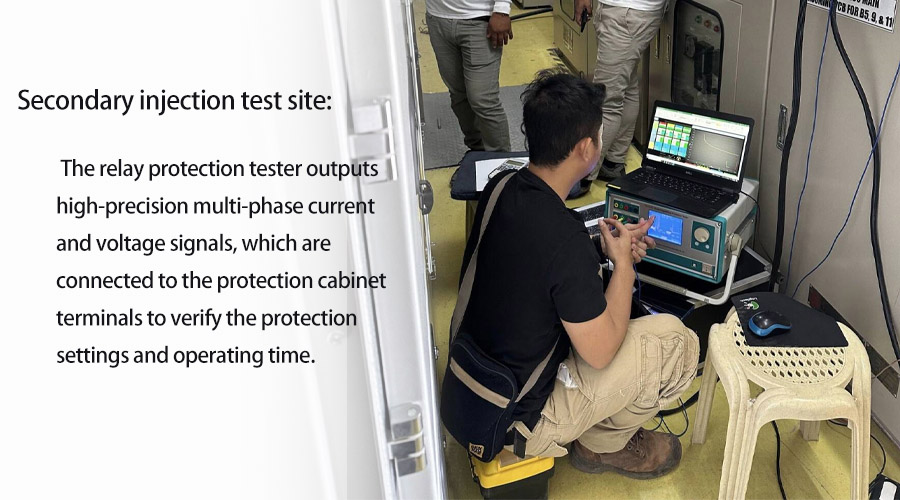
Relay protection test series products←
Comparison: Primary vs. Secondary Testing Equipment
| Aspect | Primary Equipment Testing | Secondary Equipment Testing |
| Test Object | Transformers, circuit breakers, cables, surge arresters | Protective relays, bay control units, control circuits |
| Voltage / Current Level | High voltage / high current | Low voltage / low current |
| Primary Goal | Insulation, conduction, mechanical integrity | Logic, accuracy, timing, protection functions |
| Typical Equipment | Hipot testers, circuit breaker analyzers, winding resistance meters, tan delta testers | Relay test sets, secondary injection testers, digital multimeters |
| Safety Risk | High | Low |
| Portability | Usually heavy, requires transport carts | Generally portable, benchtop or ruggedized |
| Automation Level | Moderate | High |
| Applicable Standards | IEC 60076, IEC 62271, IEEE C57 | IEC 60255, IEC 61850, IEEE C37 |
In-depth Analysis:
Safety: Primary testing involves potentially fatal high voltages and currents, requiring equipment with redundant safety interlocks, grounding systems, and remote operation capabilities. While secondary testing carries lower risk, careful isolation is still necessary to prevent accidental tripping commands or damage to sensitive electronic components.
Test Objective: Primary testing answers the question, "Can the equipment survive and function properly under pressure?" Secondary testing answers the question, "Can the device correctly identify and respond to faults?"
Portability: Primary testing equipment is typically bulky and requires vehicle or trolley transport. Secondary testing equipment is becoming increasingly compact, with some handheld devices available for rapid checks; however, high-end relay protection testers still employ ruggedized portable designs to meet on-site commissioning needs.
Selection Guide: How to Choose?
When selecting testing equipment, please follow these three steps:
Step 1: Confirm Standards Compliance
Ensure the equipment complies with internationally recognized standards, focusing on:
CE Certification – European Market Access
IEC 61010 – Safety of Electrical Test Equipment
IEC 60255 – Measuring Relays and Protective Equipment
IEEE C57.12 – Transformers, IEEE C37 – Switchgear
ISO 9001 – Manufacturer Quality System Certification
Compliance not only ensures safety and accuracy but also guarantees your test results will be recognized by global power companies and regulatory bodies.
Step 2: Balancing Field Portability and Laboratory Accuracy
Achieving a balance between mobility and accuracy requirements:
Field Testing: Prioritize lightweight, rugged, battery-powered instruments with clear displays and simple interfaces. Pay attention to protection ratings and operating temperature ranges.
Laboratory Testing: Focus on the highest accuracy, resolution, and stability; benchtop equipment with advanced analysis software is preferred.
Hybrid Solutions: Many modern testing devices combine portability with laboratory-grade accuracy, suitable for various applications.
Step 3: Software and Automation Capabilities
Overseas customers generally consider software ease of use and automated reporting capabilities to be the most important decision-making factors. Please pay attention to:
Intuitive PC software supporting test plan creation
Automatically generated test reports with customizable templates
Database management supporting historical result queries and trend analysis
Remote control and data transmission via USB, Ethernet, or Wi-Fi
Compatible with IEC 61850, supporting digital substation testing
A powerful software suite reduces human error, saves time, and provides traceable documentation for easy auditing.
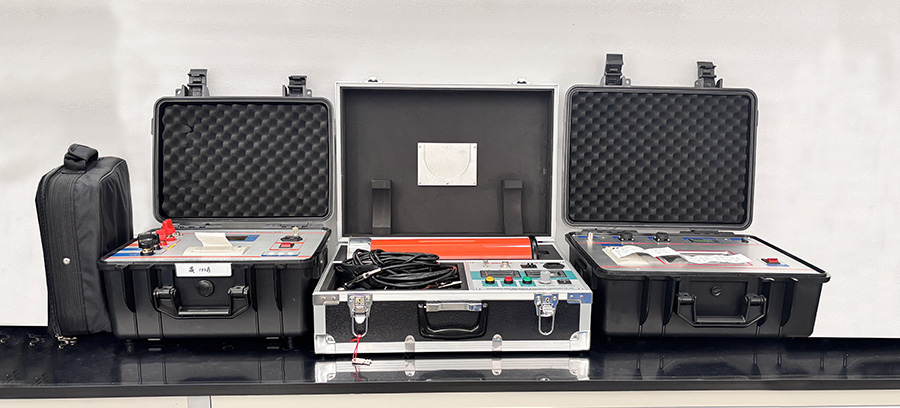
Full range of power testing equipment←
There is no inherent superiority of one over the other in primary testing equipment compared to secondary testing equipment; the key lies in choosing the right solution for the specific needs. Primary testing ensures the physical integrity of high-voltage equipment, while secondary testing guarantees the intelligence and reliability of protection and control systems. By following the selection guidelines mentioned above—confirming standards, balancing portability and accuracy, and prioritizing software—you can build a comprehensive set of testing tools that balances safety, efficiency, and data quality.
As a professional manufacturer with over 20 years of experience, Chongqing Gold Mechanical&Electrical Equipment Co.,Ltd. develops and produces a full range of power testing equipment, including transformer testers, circuit breaker characteristic testers, relay protection testers, withstand voltage testers, and cable fault testers. Our products comply with CE, IEC, and IEEE standards and are trusted by power companies and service providers in over 50 countries.
Contact us for a quote and a customized project plan.
