
 English
Views: 2 Author: Site Editor Publish Time: 2026-08-12 Origin: Site

Loop resistance testing is the most basic and easily underestimated item in the preventive testing of high-voltage circuit breakers. Many field personnel are accustomed to simply connecting the test clamp, pressing the start button, reading the data, recording it, and calling it a day—this process itself is not problematic. However, the setting of the test duration corresponds to different purposes for obtaining physical information. Understanding this helps to glean more status clues from the same equipment. This article uses the GDHL-100A loop resistance tester as an example to discuss the actual impact of test duration setting on the interpretation of measurement data.
GDHL 100A, 200A, 400A Circuit Breaker Contact Resistance Tester, Loop Resistance Tester
Why do measurement readings change with the duration of current application?
First, it's important to understand a fundamental fact: the contact resistance of the object being measured doesn't change spontaneously in a short time. What changes is the instrument's reading—it gradually approaches the actual metal contact resistance as the current continues to be applied.
The underlying mechanism is the microscopic physical process at the contact interface. When a large current in the hundreds of amperes passes through the contact surface, the current highly concentrates at the microscopic conductive spots, forming a very high local current density and generating a significant Joule heating effect. This heat causes the contact point temperature to rise by tens of degrees Celsius within seconds, leading to microcracks in the surface oxide film due to the difference in thermal expansion coefficients between the oxide film and the base metal. Under the continuous action of the current, these cracks locally melt or peel off, increasing the effective area of the current channel. Macroscopically, this manifests as a slight decrease in the instrument's reading at the beginning of current application, gradually stabilizing.
This process almost never occurs with small currents in the milliampere range—the current energy is insufficient to generate a significant temperature rise, the oxide film remains intact, and the measuring current is always blocked outside the film layer. The reading actually reflects the capacitive coupling characteristics of the film layer, not the actual resistance of the metal contact. This is precisely the physical reason why relevant standards require test currents in the hundreds of amperes range, and it forms the basis for understanding the relationship between test duration and readings.
When the current continues to the order of 60 seconds, the thermal effect spreads further from the contact point into the deeper layers of the surrounding conductor. If the contact spring exhibits high-temperature creep under the influence of the temperature field, the contact pressure will slowly decrease, while the measured value may show a continuous unidirectional increase. This change pattern is distinctly different from the "rise then stabilize" observed with simple surface film removal, providing a basis for on-site personnel to determine the nature of the defect.
What Happens Before the Reading Stabilizes?
In the first few hundred milliseconds after a large DC current is applied to the circuit under test, the measurement system undergoes a transient process: the output current of the constant current source rises from zero to the set value and completes its adjustment; the front-end filter of the voltage sampling circuit attenuates superimposed interference signals; and the analog-to-digital converter waits for the reference voltage to stabilize before it can begin effective sampling. Taking the GDHL-100A model as an example, its constant current source's current rise time is designed to be within 300ms. Combined with the fast stabilization characteristics of the front-end filter, the process from current establishment to effective sampling can be completed in approximately one second.
However, electrical system stability does not equate to the physical state of the contact interface being stable. The aforementioned Joule heating effect occurs immediately after current establishment. The time constant of the contact point temperature rise process roughly overlaps with the electrical transient process, but the two belong to different categories in terms of physical mechanism. Therefore, the reading given by the measuring device approximately one second after current establishment actually reflects the contact resistance value after initial thermal equilibrium, rather than the pure ohmic contact result in a cold state.
This difference has little impact in most routine tests—the pass/fail values given in the procedures have already taken into account the inherent characteristics of the test methods—but when it is necessary to determine whether there is an abnormality in the contact surface, this "reading after initial thermal equilibrium" is itself a useful reference point.
Additional Information Revealed by 60 Seconds of Continuous Current Application
If the current duration is extended to the order of one minute, the thermal effect diffuses from the contact point to the surrounding conductors. The observable phenomena can be broadly categorized into two types:
The first type is the stable reading after thermal equilibrium. When the contacts are in normal condition and the contact pressure is sufficient, the resistance value tends to stabilize after an initial rise, with fluctuations typically not exceeding 1-2 μΩ over the following tens of seconds. If a continuous and unidirectional slow rise occurs, attention should be paid to whether there is stress relaxation in the contact spring under the influence of the temperature field—this problem is not uncommon in older circuit breakers. High-temperature creep of the spring material leads to a gradual decrease in contact pressure over the years, but this is often difficult to detect in static measurements; it only manifests as an abnormal positive temperature coefficient of resistance under continuous current-carrying conditions.
The second type is the traces left by the process of the contact surface film being burned away by the current. If there are trace amounts of contaminants or a loose oxide layer on the contact surface, the initial reading may be higher. However, with the continuous action of Joule heating, the contaminants are burned off, exposing the underlying metal. The resistance value will exhibit a process of first rising and then falling, or first rising and then stabilizing. This characteristic is clearly different from the continuous rise caused by insufficient spring pressure in terms of waveform, allowing on-site personnel to make a preliminary judgment on the nature of the defect without disassembly.
In the continuous power-on mode of the GDHL-100A, the LCD screen refreshes the current resistance value in real time, allowing operators to observe the value's change trajectory without any additional intervention. This function is designed to facilitate the capture of these two different types of changes.
Engineering Basis for Selecting Test Duration
Based on the above analysis, the choice between the two time settings should not be simply understood as "fast mode is suitable for batch testing, slow mode is suitable for analytical testing," but should be based on the information acquisition needs.
Short-time power-on is suitable for testing scenarios where the sole purpose is pass/fail determination—factory inspection, handover acceptance, and routine retesting during periodic maintenance. In these scenarios, testers have historical data for reference and only need to confirm whether the current reading falls within the allowable range and whether there is a significant deviation from previous years' data. For most devices in good condition, short-time readings provide sufficient judgment information.
The value of long-time power-on lies in providing further diagnostic tools when short-time readings show abnormalities or suspicious changes. For example, a device might measure a value that is 8-10 μΩ higher than last year, but still within the specification limit—a situation frequently encountered in maintenance sites. In this case, observing the resistance value over time with long-time power-on can help distinguish whether this is due to slight surface contamination or a substantial change in the internal contact structure. The former can be restored to normal after cleaning the contacts, while the latter may involve replacing the spring or even the entire contact. The operation time and spare parts preparation for the two solutions are completely different.
Comparison with Historical Data
The value of data storage is even more fully realized in long-term testing. Many testers are accustomed to only recording the final resistance reading, but if the resistance values at different time points within a 60-second period—such as the 5th, 15th, 30th, and 60th seconds—can be recorded and saved simultaneously, a unique "thermal response characteristic curve" can be formed for each device after years of accumulation. Different devices and different fault types correspond to different curve shapes, which has direct reference value for trend prediction after establishing a device status database.
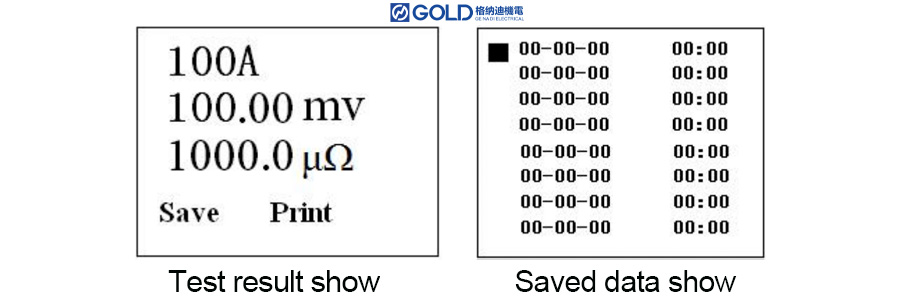
GDHL-100A tester can save up to 100 sets of test records, each containing complete test parameters and results. In standard measurement mode, the instrument automatically updates and displays the real-time resistance value. Field personnel can observe the numerical changes during the test and record their characteristics in the remarks column, which are then stored in the historical archive along with the final resistance value. After uploading to a computer via the RS232 interface, years of time-division data can be organized into a dedicated thermal response characteristic curve archive for each device.
The selection of the measurement duration for loop resistance testing directly affects how much information can be obtained in a single test. Short-term tests provide judgments, while long-term tests offer analytical support; only by combining the two can a balance be struck between efficiency and depth. The GDHL-100A is designed to provide both testing modes and a complete data recording channel, based on an understanding of the actual needs of on-site maintenance work—allowing testers to efficiently complete routine screenings on the same instrument, as well as to thoroughly investigate the causes of anomalies.
