
 English
Views: 3 Author: Site Editor Publish Time: 2026-07-30 Origin: Site

However, the efficiency of a dielectric test set does not depend on a high kVA rating alone. It depends on how precisely that capacity matches your Device Under Test (DUT), test voltage, and onsite input power supply.
1. The Math Behind kVA: It's All About Reactive Power
P = 2π · f · C · U² · 10⁻⁹ (kVA)
Where:
P: Required test transformer capacity (kVA)
f: Power frequency (50 Hz or 60 Hz depending on your region)
C: Total equivalent capacitance of the DUT to ground (pF, picofarad)
U: Target test voltage applied to the DUT (kV)
Two Inviolable Rules from the Formula:
Capacitance Dictates Capacity: Long-run power cables, large power transformers, and extended busducts are major capacitive loads. They "drink" kVA heavily.
The Voltage Square Law: The capacity demand scales quadratically with voltage. If you double the test voltage, the required kVA quadruples (2² = 4). High-voltage testing capacity demands accelerate rapidly, never linearly.
2. Low kVA vs. High kVA: Real-world Field Performance
Low Capacity Units (under 10 kVA)
Best for: Routine workshop testing, low-power distribution components, and small distribution transformers.
Pros: Highly portable, rapid setup, single-operator maneuverability, and minimal budgetary impact.
Best for: Short-run MV/HV cables and medium-sized power transformers.
Why it matters: Attempting these tests with an undersized unit slows down the voltage ramp drastically. You will observe fluctuating voltmeter needles on the control console and noticeable voltage drops during the 1-minute withstand phase. Unstable voltage corrupts insulation breakdown diagnosis. Field testing crews rely on this mid-tier for flat, predictable voltage ramps and stable hold phases.
High Capacity Systems (50 kVA and Above)
Best for: Long-distance high-voltage power cables, substation main transformers, and multi-panel busbar configurations.
Crucial Consideration: At this threshold, you must audit the onsite utility source. A 50 kVA Hipot set drawing from a single-phase 220V/240V supply can pull well over 200 Amps. Standard commercial outlets will trip instantly. Without a dedicated heavy-duty power feed or a mobile generator, the test set becomes useless inventory.
3. Quick Reference: DUT vs. Recommended kVA Sizing Matrix
Note: Capacitance values fluctuate widely by manufacturer, insulation material (XLPE vs. PILC), and structural configuration. Always conduct a capacitance measurement prior to final equipment commissioning.
| Device Under Test (DUT) | Typical Specifications | Test Voltage (kV) | Est. Capacitance (pF) | Recommended Capacity | Practical Field Insight |
| Distribution Transformer | Oil/Dry type, ≤2500 kVA | 28 – 34 | 1,000 ~ 3,000 | ≥ 5 kVA | 5 kVA covers standard loads; scale to 10 kVA for larger ratings. |
| MV Power Cable | 300 mm², ~1 km (0.62 miles) | 21 – 24 | ~300,000 (0.3 μF/km) | ≥ 25 kVA | Longer runs heavily strain capacity. Do not undersize cable testers. |
| HV Switchgear / Busbar | Multi-bay coupled setup | 38 – 50 | 5,000 ~ 10,000 | ≥ 15 ~ 25 kVA | Parallel coupled bays amplify total capacitance fast. |
| Substation Main Transformer | Dual-winding, ≤63 MVA | 140 – 160 | 5,000 ~ 8,000 | ≥ 50 ~ 100 kVA | Requires rigorous calculation via nameplate specs. No guesswork. |
| HV Industrial Motor | Stator windings | 15 – 24 | Tens of thousands | ≥ 10 ~ 15 kVA | Megawatt-class motors exhibit high capacitance; low kVA units stall. |
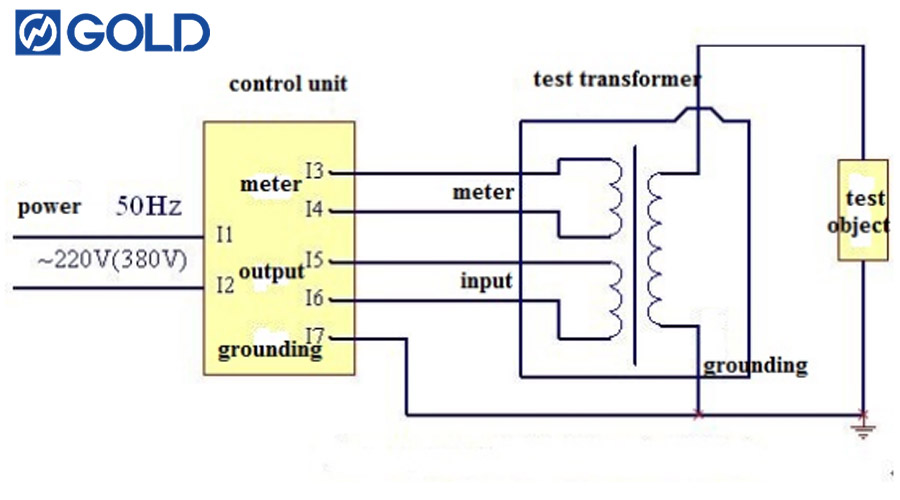
GDJ Oil-Immersed Test Transformer Wiring Diagram
4. A 3-Step Selection Protocol
Define the Scope: Catalog your exact test objects. Are you servicing standard distribution assets or high-capacitance infrastructure?
Run the Calculus: Verify the target test voltage from your regional standard (e.g., IEEE 400, IEC 60502), identify the asset capacitance, and calculate using the formula above or cross-reference our sizing matrix.
Apply an Engineered Safety Margin: Add a 10% to 20% buffer to your calculated kVA. This accounts for environmental variations, field losses, and future asset profile expansions without doubling your equipment cost unnecessarily.
Engineering Tip: If your daily operation revolves around 11kV/22kV distribution transformer testing, a 50kV / 5kVA AC Hipot Test Set is perfectly optimized. There is no technical justification to over-spec to a 30 kVA footprint.
At GOLD, we frequently consult with international clients who heavily overestimate their kVA parameters. In most use cases, transferring your specific asset datasheets to an application engineer reveals that a streamlined 5 kVA or 10 kVA system solves the requirement while cutting capital expenditure.
