
 English
Views: 0 Author: Site Editor Publish Time: 2026-09-18 Origin: Site

When a Single BDV Number Lies
The following sequence is an illustrative example based on common field patterns, not a specific incident report. A maintenance team pulls an oil sample from a 220 kV transformer. GDYJ‑505H 80 kV transformer oil BDV tester runs six breakdowns. The readings scatter: 62 kV, 48 kV, 39 kV, 55 kV, 41 kV, 51 kV. The computed average lands near 49 kV—technically "Fair"under IEC 60422, but the spread is the real signal. Stable oil produces tightly clustered readings. A wide scatter points to particulate contamination migrating between electrodes, not a uniform moisture problem. The transformer passes the threshold. The oil does not pass the diagnostic. This distinction—between a value and a pattern—is where BDV testing either protects assets or becomes a compliance ritual.
What IEC 60156:2025 Actually Specifies
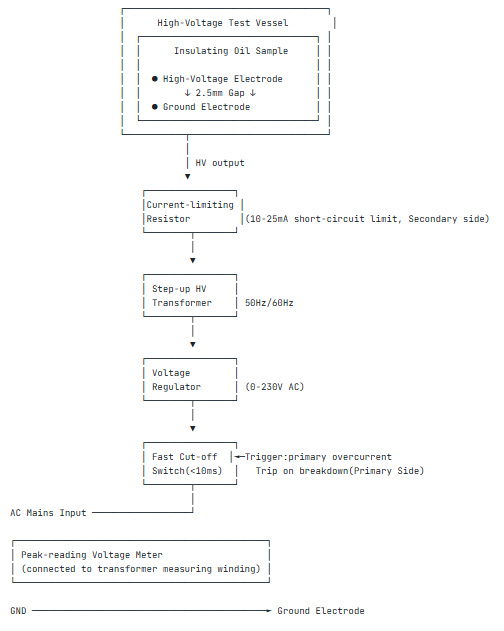
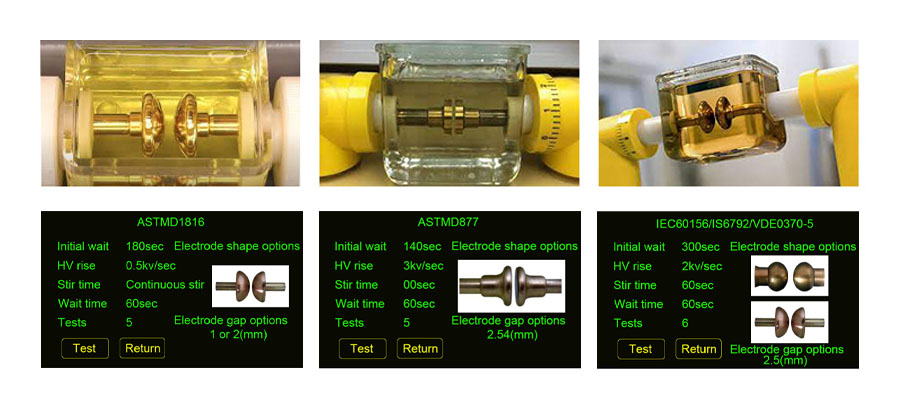
IEC 60156:2025 is the current governing standard for determining dielectric breakdown voltage at power frequency. The standard applies to all insulating liquids with nominal viscosity up to 350 mm²/s at 40 °C, covering mineral oils as well as natural and synthetic esters now deployed in renewable‑energy transformer fleets. The test uses spherical electrodes spaced at 2.5 mm, with voltage ramped at 2 kV/s until breakdown.
▎The normative main method of IEC 60156:2025 requires six breakdown measurements on the same sample filling, with results averaged directly. An optional informative improved procedure given in Annex A uses ten breakdowns; the two highest and two lowest results are discarded before calculating the mean and coefficient of variation for higher‑precision testing. ▎
One procedural detail that field teams often skip: sufficient rest intervals between individual breakdown measurements to allow gas bubbles generated by the preceding arc to dissipate. When required rest intervals are compressed—common in high‑throughput labs—the second and third readings can be artificially depressed, mimicking contamination that is not actually present in the sample.
The IEC 60422:2024 Threshold Framework
IEC 60422:2024 replaced the 2013 edition and provides supervision and maintenance guidance for mineral insulating oils in transformers and other electrical equipment. The document categorises in‑service oil quality across multiple parameters‑colour, water content, interfacial tension (IFT), BDV, acidity, and dielectric dissipation factor (DDF)‑and includes guidance on reconditioning, reclaiming, and PCB decontamination.
For BDV specifically, below are general guideline thresholds grouped by transformer voltage class.
Note: exact acceptance limits shall be confirmed against the latest IEC 60422 release and the original‑equipment‑manufacturer specifications for each asset.
| Transformer voltage class | BDV condition | Action required |
|---|---|---|
| < 72.5 kV | 30–40 kV | Monitor closely |
| 72.5–170 kV | 40–50 kV | Observe / plan filtration |
| > 170 kV | ≥ 50 kV (new oil: ≥ 60 kV) | Below 50 kV indicates reconditioning needed |
▎Table reflects industry‑interpreted guideline ranges derived from IEC 60422:2024; limits vary with oil formulation, equipment criticality and OEM requirements. Always refer to official standard text and manufacturer documentation for project‑specific values.
The critical nuance: IEC 60422 does not set a rigid single “pass/fail” BDV number. It classifies oil condition across a graded scale and emphasizes that BDV results must be evaluated alongside moisture, acidity, and DGA trend data. A BDV reading of 48 kV in a 220 kV transformer is not automatically “acceptable”; it sits in the observation band, and sequential quarterly‑sample trends determine whether intervention becomes necessary.
Reading the Scatter: Three Patterns That Point to Contamination Type
Pattern 1: Uniformly Low, Tight Scatter
Readings cluster in a narrow band‑for example 32–36 kV across six breakdowns. This pattern points to dissolved moisture. Water molecules distribute homogeneously within the oil volume, uniformly depressing dielectric strength. The appropriate remediation is vacuum degassing rather than mechanical filtration, since dissolved water cannot be removed by particulate filter media.
Pattern 2: Wide Scatter with a Downward Drift
Readings start high and progressively drop: 62, 55, 48, 41, 39, 36 kV. This is the signature of particulate contamination. Each breakdown arc generates carbon particles and vaporises small volumes of oil; those particles migrate into the electrode gap and seed subsequent breakdowns at lower voltage levels. A downward trend within a single test cycle is diagnostic; uncontaminated, stable oil will not demonstrate this drift.
Pattern 3: Uniformly Low with Occasional High Outliers
Readings oscillate unpredictably: 28, 45, 31, 48, 27, 50 kV. This pattern suggests free gas bubbles trapped within the test vessel. Gas bubbles possess far lower breakdown strength than the surrounding liquid, and bubble positioning relative to the electrode gap changes between individual breakdown shots. Root causes most often relate to sampling technique‑such as drawing oil too rapidly or using an inadequately flushed valve.
Each contamination pattern calls for a distinct corrective workflow: filtration addresses particulate ingress, vacuum degassing addresses dissolved moisture, and revised sampling protocols eliminate free‑gas artefacts. Running all three remediation workflows “just in case” wastes labour, time and operating budget.
Matching the Instrument to the Diagnostic Task
Laboratory Throughput with Diagnostic Depth
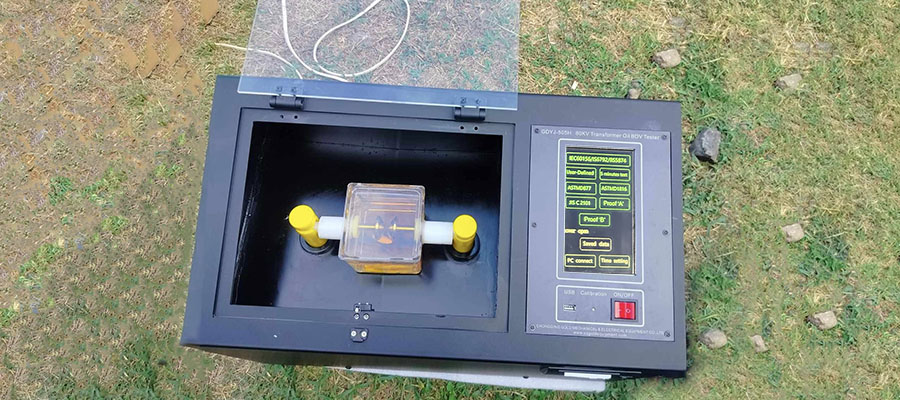
Chongqing Gold GDYJ‑505H 80 kV touch‑screen transformer oil BDV tester runs automated ramp‑breakdown‑stir‑settle test cycles, with native preset routines fully compliant with IEC 60156, ASTM D877, ASTM D1816, JIS C 2101‑99(s) and other global test standards. Output voltage spans 0‑80 kV (0‑100 kV optional), offering selectable ramp‑rate options: 0.5 kV/s, 2 kV/s, 3 kV/s and 5 kV/s. Measurement accuracy: ±(1 % of full‑scale + 2 digits), resolution 0.1 kV. The instrument supports configurable test cycles from 1‑9 runs, compatible both with IEC 60156 main‑method 6‑shot routine and Annex A improved‑method 10‑shot routine. It stores test data for trend analysis, incorporates built‑in real‑time oil‑temperature sensing to log sample temperature for each run, and exports saved results to PC reporting software via USB connection. Stir time is adjustable from 0‑999 seconds and wait‑settle time adjustable 0‑600 seconds, allowing operators to fine‑tune rest intervals according to scatter patterns observed in test data.
For high‑volume laboratories processing 20+ samples daily, our GDYJ‑502A 80/100 kV model expands throughput capability with the same comprehensive multi‑standard preset test library, high‑accuracy measurement, PT100 oil temperature monitoring and large‑capacity internal data storage of up to 100 groups of test records.

Field Diagnostic First‑Response
GDYJ‑501 80 kV transformer oil BDV tester delivers 0‑80 kV output (customisable to 100 kV), with default 2 kV/s ±10 % voltage‑rise rate, maximum of nine test cycles, and measurement error ≤3 % across the 10‑100 kV measurement range. It supports IEC‑standard test cycles plus Proof A / Proof B withstand‑voltage validation workflows, stores up to 100 groups of test records, and supports PC data upload so field‑acquired measurements can be merged into the same trend databases used for laboratory‑generated results.
The practical operational advantage: when field‑service teams observe wide result scatter during an initial test cycle, operators can adjust timing parameters to execute a targeted diagnostic retest of the same sample before the 24‑hour post‑sampling window alters particulate distribution within the oil.
A Documented Intervention Sequence
Based on a publicly‑documented case study from an independent oil‑purification‑equipment manufacturer:
A regional substation in Bangkok reported an initial BDV reading of 45 kV for a critical transformer‑within the “Fair” guideline band but showing downward trends across two sequential quarterly sampling rounds. On‑site vacuum oil‑purification equipment was deployed instead of full oil replacement. After 72 hours of continuous on‑line processing, the oil breakdown‑voltage value reached 78 kV, exceeding typical new‑oil specification benchmarks.
▎Note: This case describes purification work carried out by third‑party vacuum filtration systems. GDYJ‑series instruments are breakdown‑voltage testing analysers used for measuring oil quality, not oil‑purification hardware.
The intervention represented only a fraction of the total cost for complete oil replacement and prevented extension of a planned equipment outage.
This real‑world‑style case illustrates a core operating principle: BDV testing defines intervention urgency rather than delivering a simple binary pass‑fail status. A 45 kV reading on a 115 kV transformer may grant lead‑time for scheduled, targeted remediation. That identical reading on a 500 kV unit would trigger immediate escalation.
From Measurement to Decision
The IEC 60156 method defines how to perform BDV measurement. IEC 60422 defines what numerical results mean within real‑world asset contexts. The practical gap between standard procedure and actionable maintenance decisions is filled by instrument measurement precision, the technician’s ability to interpret result‑scatter patterns, and the willingness of maintenance teams to act on multi‑sample trend data instead of relying exclusively upon isolated threshold crossings.
Explore the full insulating‑oil dielectric‑strength tester portfolio from Chongqing Gold Mechanical & Electrical Equipment Co.,Ltd.— ranging from laboratory‑grade GDYJ‑505H and high‑capacity GDYJ‑502A platforms to the field‑ready portable GDYJ‑501 analyser. Contact our electrical engineering team for custom selection consultation matched to your transformer voltage class, fleet scale, and asset‑contamination‑risk profile.
