
 English


 |


| Quantity: | |
|---|---|
GDZC-50S
CHONGQING GOLD
USB Interface Three-Channel Winding Resistance Tester with 7-inch Color Touchscreen
Transformer winding DC resistance testing is not merely a single-point pass/fail inspection; its greater value lies in long-term trend comparison and analysis spanning factory acceptance, field handover, major overhauls and renovations, and periodic pre-testing.
In actual operation and maintenance, a large number of field-collected test records lose their reference value for asset assessment: additional impedance interference from neutral point lead-out cables, residual magnetism in the core affecting subsequent test readings, inconsistent temperature conversion conditions, and lack of complete environmental context in stored records make it impossible to compare test data from multiple years and batches, hindering the identification of potential slow winding degradation.
GDZC-50S eliminates these interference factors at their source, producing measurement datasets with cross-cycle comparability.
It covers YN star, D(Y) delta configurations, and large five-limb core power transformers. The entire unit integrates multi-channel synchronous sampling, neutral point loop offset correction, magnetization acceleration saturation, and post-test demagnetization, all housed in a portable protective chassis. Each storage record comes with complete environmental metadata, allowing engineers to compare test results from months or even years apart, identify progressive winding degradation, and support power equipment asset management.
Key advantages
▲ 1. Complete Metadata Storage Enables Cross-Period Data Comparability
Simply storing resistance values is insufficient for long-term asset assessment. This instrument automatically binds each test file with tap position number, measured winding temperature, copper/aluminum winding material identification, resistance value converted to reference temperature, and three-phase imbalance rate, along with hardware-generated immutable timestamps. It produces a complete dataset suitable for audit traceability, enabling cross-sectional comparison of data from different stages—factory delivery, handover, and periodic maintenance. It supports on-board thermal paper output, batch export to USB flash drive, and RS232 upload to laboratory databases.
▲ 2. Neutral Point Loop Offset Correction Eliminates Data Deviation Caused by External Cables
For YN winding transformers with long neutral point lead cables, the cable impedance itself alters the three-phase balance statistics, causing inconsistencies between three-phase measured data and single-phase reference measurement results. The instrument provides switchable neutral point offset correction logic. Field technicians can enable or disable compensation based on actual wiring conditions, ensuring alignment between multi-channel synchronous test results and single-phase reference readings, avoiding misjudgments of winding defects.
▲ 3. Accelerated Magnetization for Five-limb Core Triangular Winding Transformers
The low-voltage triangular winding of a five-limb core high-capacity transformer requires a long magnetic circuit establishment time under traditional DC excitation, occupying valuable power outage maintenance windows. The instrument's built-in high- and low-voltage series-connected magnetization circuit eliminates the need for external auxiliary equipment, accelerating core saturation and shortening the stabilization waiting time for large-capacity transformer triangular winding tests.
▲ 4. On-site Demagnetization After Testing, Ensuring Fidelity of Subsequent Test Data
DC excitation leaves residual magnetism inside the transformer core. This residual magnetic flux introduces systematic deviations into subsequent no-load loss, impedance, and winding deformation tests. After completing DC resistance acquisition, the existing test wiring can be used to directly execute the demagnetization process without re-disassembling cables, ensuring data consistency across the entire transformer diagnostic project.
▲ 5. Controlled Energy Release Process for Inductive Loads, Avoiding the Risk of Human Error in On-site Operations
Transformer windings are large inductive loads, storing a significant amount of energy after current flow. The instrument provides more than just audible and visual alerts; it fully executes a controlled energy release workflow. If the discharge process is incomplete, it locks the start permission for a new round of testing, preventing the risk of arc flashover caused by personnel prematurely removing the test clips during busy substation operations.
▲ 6. Dual Independent Terminal Layout, Bilingual Touchscreen Parameter Configuration
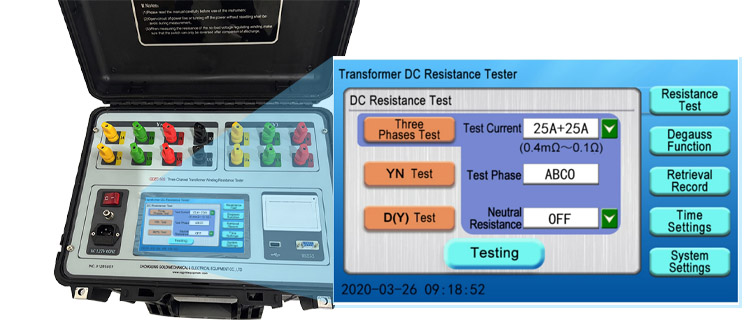
The instrument distinguishes between independent terminal groups for YN and D (Y) windings, reducing the probability of incorrect terminal connections. A 7-inch bilingual (Chinese and English) touchscreen allows operators to set winding material, test current range, tap position number, and actual measured temperature. The system automatically retrieves the corresponding temperature drift coefficient and outputs the standard converted resistance value, providing a basis for comparison of data collected under different ambient temperatures. Weighing only 12.8kg, the instrument is suitable for both laboratory benchtop use and outdoor transport in substations.
Technical Specifications
| Item | Specification |
|---|---|
| Model | GDZC‑50S |
| Three‑phase selectable test current | 25A+25A, 10A+10A, 5A+5A, 1A+1A, 200mA+200mA, 20mA+20mA |
| Single‑phase selectable test current | 50A, 20A, 10A, 5A, 1A, 200mA, 20mA |
| Measurement Accuracy | ±(0.2% reading + 2 digits) |
| Minimum Resolution | 0.1 μΩ |
| Operating ambient temperature | -10℃ ~ 40℃ |
| Relative Humidity | ≤80%RH, non‑condensing |
| Mains Input | AC220V±10%, 50Hz±1Hz |
| Local storage capacity | Up to 100 sets of metadata‑attached test datasets |
| Interfaces | USB‑Host for flash‑disk export; RS232 for PC‑side data integration |
| Display | 7‑inch color touch‑screen, Chinese‑English bilingual UI |
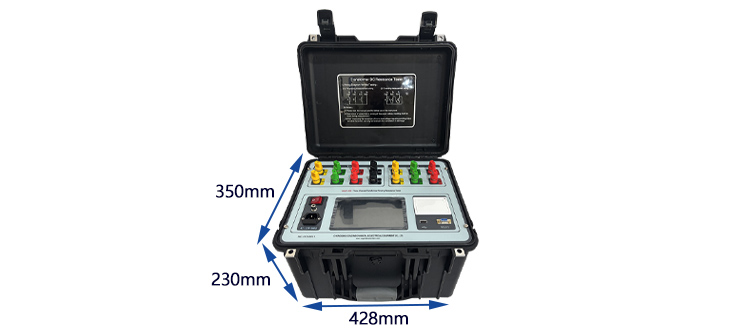
| Outer dimension(L×W×H) | 428 mm × 350 mm × 230 mm |
| Net Weight | 12.8 kg |
Delivered Kit Contents
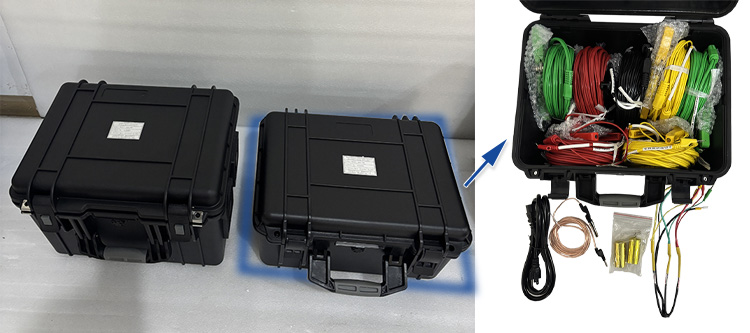
1 × GDZC‑50S 3‑Channel DC‑Resistance Tester Main Unit
Full‑set dedicated test‑cable assemblies for YN‑mode and D(Y)‑mode terminals
1 × reference calibration standard resistor
2 rolls thermal printer paper
2 spare fuses
Protective‑earth cable, AC‑220V power‑supply cord
Bilingual operation instruction manual
Factory calibration verification document
Q:What value does metadata‑attached logging bring for transformer asset‑management?
A: Raw resistance numbers alone cannot support long‑term health trending. Each dataset stores tap‑number, on‑site temperature, winding material tag and normalized resistance together with hardware timestamp. This allows engineers to compare measurement data taken years apart and spot slow winding degradation, rather than only judging pass/fail for a single test event.
Q:Under what scenario should neutral‑lead offset compensation be toggled on?
A: Turn it on for YN‑configured transformers with long neutral outgoing cables carrying noticeable impedance. For installations where neutral‑point connects to ground over very short conductors, keep compensation disabled to prevent extra correction‑related deviation.
Q:Do I need to re‑route cabling when running post‑test demagnetization?
A: Demagnetization procedure re‑uses existing field‑wiring after DC‑resistance measurement finishes, eliminating extra on‑site wiring labour.
Q:What prevents operators from starting new tests before inductive discharge finishes?
A: Instead of relying only on audible alerts, the instrument implements workflow interlock logic. Subsequent test sequences remain locked until inductive‑energy dissipation completes, lowering human‑error‑caused arc‑flash risks in fast‑paced substation work.
Contact us
Contact person: Christine Gou
Whatsapp/Wechat/Mobile: +86 15123029885
Email: gold05@hy-industry.com
